You Should Have A Date Night

56078886

“I believe the change in attitude came from truly connecting and tuning in at home. This required disconnecting from work (e.g. turning off the computer and phone), and completely focusing all of my attention on the details of the home. Cooking a great meal. Helping with a science project. Discussing the future with my partner.”

— Scott Weiss, “Success at Work, Failure at Home

A great article by Scott on the challenges of balancing work/life when you’re the CEO of a growing startup. I think the insights are broadly applicable outside of just the CEO role. For me, working at startup after being at big company for 10 years has forced me to rethink several key parts of my own personal work/life balance.

I love to work, so a while back Amy and I worked on a few simple “strategies” for ensuring we stay connected regardless of how intensely I throw myself into my job. My favorite, Friday Date Night, is something we loved doing in Seattle and have picked up with gusto here in NYC. We need to work on “leaving our phones in our pockets”, but making sure we have one or two dedicated nights per week of just cooking dinner, binge-watching Netflix, and drinking good wine definitely helps keep me grounded.

Another strategy we’ve adopted is simple but effective: shared calendars and weekly planning. On Sunday nights Amy and I discuss the week and plan out what dinners, events, and shows we have planned, and then make sure our calendars are up to date. This helps because I can then identify one to two nights where I can work late without feeling bad, because I know Amy has a sorority alumni event or drinks with her girlfriends planned. You can’t always plan the work days that are going to turn in late nights at the office, for sure. For me, knowing I have some evening time where I can crush some deliverables, answer queued emails or do market research without stressing that I’m late for dinner makes it way easier to leave at a decent hour on a night that Amy and I have plans.

How do you maintain your balance?

Crossfit & Startups Are Basically The Same Thing

IMG_4749

“Leave all the afternoon for exercise and recreation, which are as necessary as reading. I will rather say more necessary because health is worth more than learning.” — Thomas Jefferson

I was recently at a startup event here in NYC and was having a great conversation with a random set of folks. We all started shaking hands in preparation of splitting up, ready to charge forward and continue networking with other people. I extend my hand to one of the woman to shake goodbye and instead she says, “Sorry, I can’t shake hands right now. I hurt mine this morning.” She turns her hand over and reveals a set of band-aids over the top part of her palm. I smile and ask “What was the workout?”, while quickly turning over my hands to show my chewed up palms and the scars of a few old but nasty tears.

We both laughed and spent a few more minutes talking about Crossfit; what our boxes (home gyms) were like, the communities there, and which movements we hated the most (her = burpees, me = rowing). It’s not the first time I’ve met a fellow Crossfitter at a startup event, and it made me reflect on the similarities between Crossfit and the actual experience of being in a startup.

Some context: I do love me some Crossfit. I can talk for hours about it because it’s something I’m passionate about and it makes me happy. I’ve been doing it for almost six years now, having worked out with Eric and Nadia at the awesome Crossfit Belltown in Seattle for many moons, then joining the very hip Crossfit South Brooklyn when we moved back to New York last year. I’ve always been an athlete through soccer, swimming, and generally being a gym rat for as long as I can remember. I love it so much I even became a personal trainer and group exercise instructor at Boston Sports Club while I was in college (I taught a pretty mean cardio kickboxing class).

So what, then, does the Venn diagram of Crossfit and a startup look like from my perspective? Here we go.

1. Efficiency and productivity.

Crossfit is intentionally intense. It’s based on the premise of high-intensity work done over short periods of time (“intervals”), meant to maximize the benefit of the exercise. I go for one hour a day, five days a week, and always feel great because I know I was as effective as possible in getting my workout in. The same set of folks go to my 6am class almost every morning and many of them are now good friends of mine. We cheer each other on while pushing each other to work as hard as possible. The unique “Workout of the Day” is always different than the prior day and never lets you feel like you’re being repetitive.

To me it feels exactly like working in a startup: every day at work is different than the last, I often work super hard for intense sprints of time, and I could never get anything done without the support of my team.

2. The right kind of competition.

My friends Peter, Brad, and I are always racing against each other in our 6am workouts. We know each others’ strengths and weaknesses, so when we’re planning out how to approach a workout we share tips and then a few taunts to push each other. The coolest part? You’re never really competing with your friends (unless you’re doing a competition), you’re pushing and competing with yourself. Whoa, #meta. Your community at Crossfit, like your team at work, are your support systems for setting personal goals and working super friggin’ hard (see point 4) to achieve them.

3. It’s all in the data.

We use an dizzying array of technology at Klink to monitor our products and users, making sure we know everything about their experience via the telemetry that gets reported to us. Combined with the fact that we are a big data company building customer intelligence solutions, and you would be correct in saying that my work is full of data. The goal is to always make measurable progress with our products and our customers.

We similarly track everything at Crossfit: how long it took to do a workout or how many reps you got, how much weight you squatted or how many pull-ups you did. There’s an important belief in the Crossfit system that you can’t improve if you don’t keep track of how you’re doing, so I use an app called MyWOD to monitor my progress and refer back to it each week as I’m planning my strategy for the different workouts.

4. It’s friggin hard.

I like to do things to the max. Crossfit workouts typically have a concept of a ‘prescribed weight’, meaning the maximum recommended weight to use. I almost always use that weight and almost always finish the workout in time (or with high reps, etc.). Yet every couple of workouts, like the 4x4x4 one from mid-January, I get completely crushed. For that one I had to lower the weight from the prescribed amount and still finished over 2min past the 10min time cap – it was one of the hardest workouts I’ve done in months. The thing that got me through it? My entire 6am class surrounded me as I pushed through the last set and cheered me when I finished (and promptly collapsed onto the floor).

Super-hard challenges requiring a ton of personal effort and the support of a team to finish? See “Working at the office until 2am on a financial model due the next morning”, or the always fun “Dogfooding a hotfix all-day on a Sunday so you can fix an urgent customer bug”.  Every week at work there’s always a day or two that feels like that 4x4x4 workout: it requires an all-out effort from everyone on the team, everyone works past the clock, and no one does it alone.

Are you a Crossfitter? What’s your favorite workout?

How I use LinkedIn as a personal CRM system

c91ae49a576c0ce9a572c1d8e0bb5cf8f6e18ba11cb23ac85aa4207111566be2

I think the single best feature of LinkedIn is one that most folks I talk to never use. I was sharing this with someone at the NYC Enterprise Sales meet-up this week and he encouraged me to write it up.

In addition to the standard ways of using LinkedIn – searching for people you’ve met or will meet, connecting with them, and then browsing their co-workers – you can use LinkedIn as a lighweight CRM system that has great mobile integration. If you’re in Sales, Recruiting, or any other discipline that requires a real CRM system than your needs are likely way beyond this way of using LinkedIn, but it works really well for me (a product guy who does a bunch of networking and hates holding on to business cards).

It’s all about the “Relationships” and “Contact Info” tab. When setup correctly and with a little effort put into note-taking, these two pieces of a contact’s profile can be very powerful for keeping track of your connection to that person.

How does it work?

It’s super simple (3 steps!), and it all starts with this magical button on LinkedIn:

Screenshot 2015-01-21 17.23.33

The first thing I do after I meet someone new is search for them on LinkedIn. Then:

  1. Click the magical “Save to Contacts” button.
    This stores their profile in your LinkedIn address book even if you’re not connected to them. I do this even before I click “Connect”.
  2. Click “How you met” and enter in some info.
    Include things like locations, events, online locations, etc. The key is to enter something.
  3. Click the “Contact Info” tab and enter in their contact info.
    This is where you can enter any private contact information you have about them from business cards, email signatures, etc.


Done! Now what?

Now you have all of the important information about that person stored in a single place, and its tied to the profile that they control the updates to. Here’s an example for my awesome friend and fellow power networker, Mark Birch:

Screenshot 2015-01-21 17.25.15

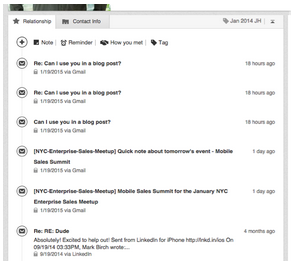
I can see a few really useful things in the “Relationship” section whenever I look at Mark’s profile, like how we met and our latest email interaction. If I expand the section I can see our entire email history:

Screenshot 2015-01-21 17.25.27

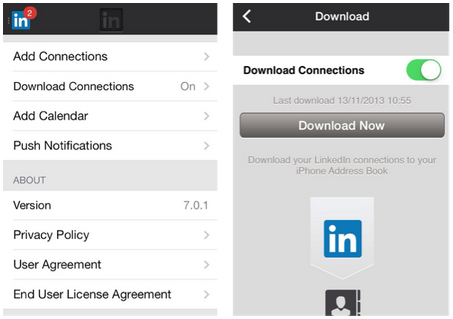
Even cooler is the mobile integration. Download the LinkedIn app for iOS or Android, and then turn on “Download Connections” in Settings:

Screenshot 2015-01-21 17.25.36

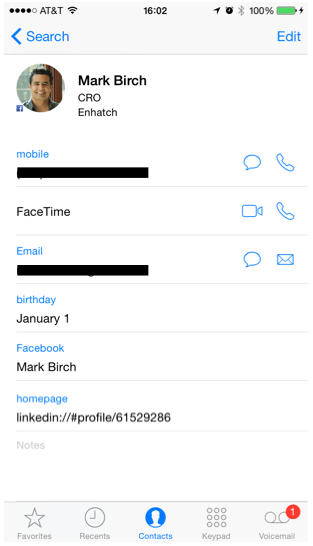
Now, all of your local contacts will get updated with all of contact details you put into LinkedIn, including their emails, phone numbers, and LinkedIn profile ID. It will also get updated when they update their profile. It will add a new contact if you don’t already have one, or sync to an existing one if it finds it. Check it out:

Screenshot 2015-01-21 17.25.45

To get the most out of this setup, you need to connect your email and calendar accounts on LinkedIn via this settings page.

My other CRM tip is to “Tag” contacts for easy follow-up and sorting. One way I’ve used it in the past is to tag folks that I wanted to physically meetup with once I moved back to NYC. I used the tag “NYC Reconnect”, and have been slowly making my way through the list (and adding a “Note” in the Relationships tab whenever we’ve met!).

I’d love to hear your tips on how you use LinkedIn as a CRM system. Later this month I’ll share more thoughts on how I network (hint: lots of coffees). Also thanks to Mark for letting me use his profiles in my blog post.

Thanks!

-m

Dressing The Part

“People still make assumptions about us based on irrelevant things like clothing and mannerisms… and height and weight and age and gender and ethnicity and tons of other qualities and attributes that have absolutely no bearing on a person’s performance.”

I read this great post by Jeff Haden on LinkedIn, “Does How You Dress and Look Impact Your Career? Sadly, Yes“, and wanted to share my own thoughts and a classic pic, thanks Mom for finding it:

1959649_10102133102482330_255152356_n
Junior high school prom, circa 1999

I remember it clearly: It was my first year at Microsoft right out of college and I was still rockin’ my blond spiked hair, earrings, and goatee. I went to my first customer event where we were meeting with C-level execs and wound up sitting down next to my VP. He turns to me and says “Wow, two earrings, huh?” Almost immediately I went to the restroom, took out the earrings, and have not worn them since.

I’m a proud supporter of individualism at work across every domain, from personality to attire to organizational styles. Working with such broadly different personalities over the years has given me some of the most rewarding experiences as a leader and contributed immensely to my personal growth.

I love working in technology for a number of reasons, one of them being its support of individualism across so many of those important domains. For me, it’s great to be able to rock flip-flops and shorts at work on a lava-hot day in NYC. At the same time, I agree with the author’s point that you have sometimes have to dress the part: either for a role you aspire to have, or for a customer you’re talking to. Today we’re meeting with a client in the financial services industry, so I’m sans flip-flops and am ready in my corporate gear (slacks + button down + blazer) to ensure my attire doesn’t get in the way of our conversation.

Link

Brilliant. Facepalm.

This NYC Startup Will Be Your Personal Digital Doorman

Link

Appearance and enunciation matter as much as content.

The Do’s and Don’t When Meeting with a VC